HomeGPT: AI Interior Design
- 4.5
- Rating
- 10.00K
- Installs
- Free
- Price

 Analysis by App-foxy
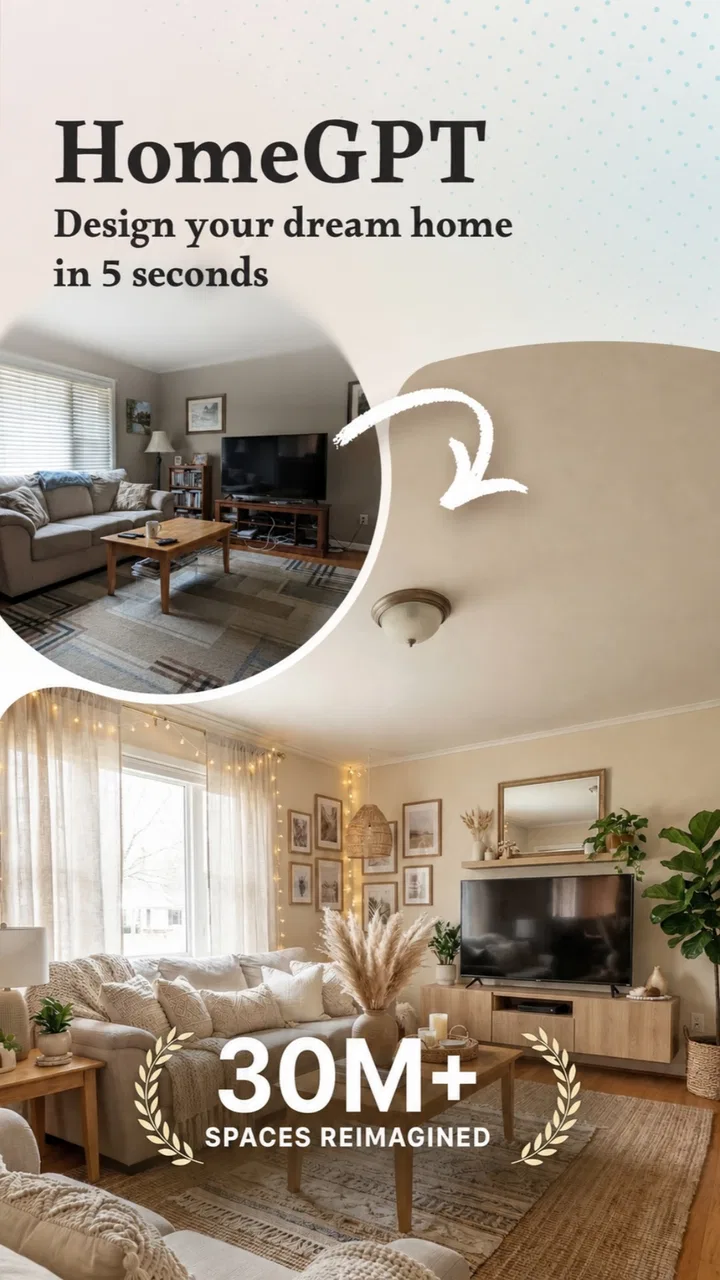
I found HomeGPT: AI Home Makeover most useful when I treated it as a visual planning partner rather than a replacement for an interior designer. Its central appeal is simple: I can use an AI-assisted approach to rethink a room, an exterior, a garden, or a floor-plan idea before committing time and money in the real world. That makes it especially interesting for anyone who has plenty of ideas but struggles to picture how they will look together.
This is a free House & Home app from Fire Elite Team, rated for Everyone and available for devices running Android 8.0 or later. It has reached over ten thousand installs and holds a 4.0 average from around eighty ratings, which gives me the impression of a small but active product rather than a mature design platform with years of refinement. The current version is 1.0.4, so I approached it with realistic expectations: useful for exploration, but not something I would rely on as the only source for construction decisions.
What the AI makeover actually adds
I would use this section to separate the visual spark of an AI makeover from the decisions that actually make a home work. The most useful gain is a quicker way to compare broad directions before I commit to purchases, but a compelling image still needs to be checked against the room’s dimensions and daily routines. That distinction leads naturally to a practical workflow: how to turn a promising concept into a useful next step.
You May Also Like

 AccuWeather: Weather Radar
AccuWeather Review: A Quick, Clear Forecast for Everyday Decisions
For everyday plans, the best forecast is the one you can understand quickly. AccuWeather makes rain timing, radar, and local conditions easy to act on, with a few trade-offs.

 Hill Climb Racing
Why Hill Climb Racing Still Turns Crashes Into One More Run
A tiny car, a bumpy hill and one more upgrade: Hill Climb Racing keeps resurfacing because its simple chaos makes every near-miss feel personal.

 AliExpress - Shopping App
AliExpress Makes Global Shopping Feel Personal, but Shoppers Bear the Risk
AliExpress turns a global marketplace into a pocket-sized discovery engine. Its reach is useful, its shopping loop compelling, and its trade-offs easy to miss.

 Lords Mobile: Kingdom Wars
Lords Mobile Is a Kingdom-Building Routine, Not a Quick Match
A case-by-case verdict on the building, battles, device demands, and social commitments that make Lords Mobile rewarding for some players and exhausting for others.

 PDF Scanner app - TapScanner
TapScanner Makes Paperwork Easier to Capture, Check, and Share
TapScanner makes scanning with a phone feel less like a rescue operation and more like a dependable step in getting work done. Its capture tools are useful, though not flawless.

 Block Blast!
 Shows How Much a Puzzle Game Can Leave Out
A quiet grid game shows why puzzle players increasingly value instant clarity, repeatable skill and low-pressure play—and where the genre still needs to catch up.
More From Our News Desk
View All News


A faster way to turn vague ideas into visual directions
The strongest capability here is the ability to explore a home redesign through generated visual concepts. In ordinary planning, I might save photographs, describe a style to a professional, or move furniture around repeatedly while trying to imagine the result. An AI makeover app shortens that first stage. Instead of asking myself whether a room could feel warmer, cleaner, more modern, or more connected to the garden, I can use a visual result to react to.
That distinction matters. I do not see the output as a final blueprint. I see it as a conversation starter with myself. A picture can reveal that I like lighter finishes but dislike a particular furniture arrangement, or that a proposed exterior style feels too dramatic for the rest of the property. The value is not only in finding a beautiful image; it is in discovering what I actually want.
The app’s focus extends beyond a single living room. Its positioning covers interior spaces, outdoor areas, gardens, and 3D floor-plan concepts. That wider scope makes it more practical for someone planning a connected project. A room makeover can look convincing on its own, yet clash with the entrance, patio, or garden. Moving between those parts helps me think about the home as one environment instead of a collection of unrelated pictures.
Why the floor-plan angle changes the experience
Many visual design tools are strongest when showing a finished-looking room from one attractive viewpoint. Floor-plan thinking is different because it asks whether the space works. Where does circulation happen? Is there enough room around a table? Does a new arrangement make a doorway awkward? A 3D floor-plan concept cannot replace precise architectural planning, but it encourages me to consider layout before getting distracted by colors and decorative details.
This is one of the less obvious strengths of the app. I can use the attractive visual side to develop a style, then switch my attention to whether the proposed arrangement makes everyday sense. If a concept looks impressive but leaves no comfortable route through the room, it has already taught me something useful. I would rather discover that during an early experiment than after buying furniture.
For renters, this approach can be valuable even when structural changes are off the table. A user can think about movable furniture, lighting mood, storage emphasis, and decorative direction without treating the result as a renovation instruction. For homeowners, it can help organize a conversation before speaking with a contractor or designer. In both cases, the app works best as a low-risk first draft.
Using visual experiments to make better decisions
I recommend changing one design question at a time. If I ask for a completely different room, new furniture, a new color scheme, and a new architectural character in one go, the result may be visually interesting but difficult to evaluate. A more disciplined process is to start with the existing purpose of the space, test a broad style direction, and then compare alternatives that change only one major factor.
For example, I might first explore a calm, uncluttered living area. After that, I could compare warmer and cooler finishes, or test whether a more open arrangement improves the room. This makes the images easier to judge because I know what caused the difference. It also prevents the common mistake of choosing the most dramatic picture rather than the option that best fits daily life.
The practical insight is to use AI for comparison, not certainty. A generated concept is most helpful when it gives me two or three directions to discuss, reject, or refine. It is less helpful when I treat one attractive result as proof that every material, proportion, or furniture size will work in reality.
How I would use it in practice
For me, a good workflow begins with one clear question, such as whether a room should feel more open or offer better storage, rather than asking for a complete transformation all at once. I would compare a small number of focused ideas, note what I like in each, and carry those preferences into measuring, shopping, or a conversation with a professional. That approach also makes the app’s visual experiments easier to assess when I am using a phone between everyday tasks.
Start with the room’s real purpose
Before creating a makeover idea, I would describe the way the room is actually used. A lounge that doubles as a work area needs a different solution from a formal sitting room. A garden used for family meals has different priorities from one intended mainly for quiet reading. This sounds obvious, but it is where many design experiments go wrong: they begin with a style label and forget the people who need to live with the result.
I would also keep the first request relatively focused. Rather than trying to solve the entire home in a single pass, I would begin with one space and one problem. That might be making a cramped room feel more open, giving a dark area a lighter mood, or finding a clearer relationship between indoor seating and an outdoor area. Once the direction feels right, I would expand the idea to nearby spaces.
This workflow makes the app more useful than casual image browsing. Browsing gives me inspiration from other homes, but it can also create unrealistic expectations because the images are detached from my own layout. A personalized makeover concept, even when imperfect, lets me ask a more relevant question: would this direction make sense in my space?
Use the app before shopping
One of my favorite potential uses is building a visual shortlist before buying anything. If I am considering a new sofa, storage unit, dining table, or outdoor arrangement, I would first decide what role the item needs to play. Then I would test the overall direction rather than shopping item by item. This reduces the chance of collecting attractive pieces that do not belong together.
The same principle applies to color. I would avoid beginning with a paint choice simply because it looks appealing in isolation. Instead, I would compare the mood of the whole room, then use the preferred concept to guide a real-world sample test. Screens and generated images are not reliable substitutes for viewing material under the room’s actual light, but they can help me narrow the field.
There is also a useful budgeting habit here. I would divide the concept into essentials and optional details. The essential layer might be a better layout or a more suitable storage approach; the optional layer might be decorative objects or a more ambitious finish. If the concept only works when every detail is purchased, it may not be a sensible plan. If the room still improves after removing the expensive extras, the idea is stronger.
A realistic everyday scenario
Imagine I have just moved into a home with an awkward open-plan area. The kitchen, dining zone, and sitting area are connected, but the furniture makes the space feel divided and difficult to walk through. I could use the app to explore a more coherent arrangement, then examine the corresponding floor-plan idea to think about circulation. Afterward, I would measure the real room, mark the doors and fixed elements, and compare those facts with the visual concept.
The app would not tell me whether a particular cabinet physically fits or whether an electrical point is in the right location. It would, however, help me decide whether I want the space to feel more social, more minimal, or more clearly divided into zones. That decision is often the hardest part because it comes before product research. Once I know the direction, shopping and professional advice become more focused.
For an outdoor project, I could use the same process with a neglected garden. I would first decide whether the priority is entertaining, low-maintenance planting, privacy, or a quiet seating area. Then I would use the visual result to compare broad arrangements. The important step would come afterward: checking sunlight, drainage, access, climate, and maintenance. The app can help me imagine the garden; it cannot observe those physical conditions for me.
Where the experience needs caution
This section looks at the gap between an attractive concept and a dependable plan, including the extra care needed when a design decision could affect safety, cost, or long-term maintenance. I would treat a network-dependent moment as a reason to pause and preserve my own notes before trying again, rather than assuming a result has been saved or can be recovered. Keeping requests focused and avoiding identifying details also makes mobile use more deliberate.
Good-looking images can hide practical problems
The main trade-off is built into AI-assisted visualization. A generated result can look polished while quietly ignoring details that matter in daily use. Furniture may appear perfectly placed without proving that it fits the actual dimensions. A garden can look balanced without accounting for growth, water needs, or seasonal changes. An exterior concept may suggest materials or structural changes that require professional assessment.
That does not make the feature pointless. It defines the correct boundary. I would use the app during the idea stage, then move to measurements, samples, and expert checks. For structural work, electrical changes, plumbing, accessibility concerns, or anything involving safety, I would choose a qualified professional over an AI image every time.
There is another limitation: visual coherence is not the same as personal suitability. A design can look fashionable and still be uncomfortable, hard to clean, unsuitable for children, or impractical for pets. I would judge every concept against routines rather than asking only whether it looks impressive on a screen.
Expect experimentation rather than one perfect answer
Users who want a precise, repeatable drafting tool may find this approach frustrating. The app’s appeal is exploratory, so I would expect to spend time comparing ideas and deciding which parts are genuinely useful. Someone looking for exact dimensions, detailed material schedules, contractor-ready documents, or rigorous architectural modeling should use a dedicated design program or consult a professional instead.
The free entry point makes experimentation easy, but in-app purchases range from $3.99 to $69.99 per item. That is an important consideration before investing heavily in a workflow. I would begin with the free experience, decide whether the visual results are relevant to my projects, and only then consider whether additional purchases make sense. I would not pay simply because a concept looks attractive; I would pay only if it saves meaningful planning time or improves a decision I was already preparing to make.
Because the app is from Fire Elite Team and is still at version 1.0.4, I would also keep my expectations measured around refinement. A newer, focused product can feel approachable and direct, but it may not offer the depth, precision, or extensive customization found in established interior-design software. That is not a flaw for casual planning, but it matters to users managing a complex renovation.
How it compares with familiar alternatives
Compared with mood boards and image-search apps, HomeGPT: AI Home Makeover gives me a more active way to test a direction. Mood boards are excellent for collecting references and materials, but they leave me to imagine how those elements combine in my own home. The AI approach is better when I need a quick visual hypothesis.
Compared with manual room-planning software, it is likely to feel less technical and more immediate. A traditional planner is usually the better choice when exact measurements and object placement are the priority. The AI approach is better at the beginning, when I am still asking what kind of atmosphere and arrangement I want.
Compared with hiring an interior designer, the app is far more accessible for early exploration, but the comparison ends there. A professional can question my assumptions, inspect the space, balance practical constraints, and coordinate decisions that an image cannot handle. I would use the app to communicate my preferences more clearly, not to eliminate expert judgment where the project demands it.
Who will get the most from it
I see the clearest fit for people who make decisions visually and want a starting point for discussing a room, exterior, or garden—not a technical substitute for measurements or expert advice. It can be especially helpful when household members need something concrete to react to before agreeing on a direction. If reliable precision, detailed drafting, or a professional renovation plan is the main need, I would choose a specialist tool or qualified adviser instead.
Best suited to visual decision-makers
I think the app is a strong fit for people who struggle to translate words into spatial ideas. If “warm but uncluttered” or “modern without feeling cold” sounds difficult to act on, visual experiments can make those preferences easier to recognize. It is also useful for people preparing a renovation conversation and wanting to arrive with a clearer sense of direction.
Renters may appreciate it because many ideas can be explored without committing to permanent changes. First-time homeowners can use it to avoid rushing into purchases before understanding how rooms relate to one another. Garden owners can benefit from considering outdoor use as part of the wider home rather than treating the garden as an afterthought.
It may also help couples or families who disagree about style. Instead of arguing from abstract descriptions, I could compare a few visual directions and identify the elements each person likes. That does not solve every disagreement, but it gives the discussion something concrete to react to.
Who should choose another tool
I would skip this app as a primary solution if I needed construction-level accuracy, detailed technical drawings, or dependable product specifications. I would also be cautious if my project involved structural alterations, accessibility requirements, complex lighting plans, or anything where a wrong assumption could create a costly or unsafe result.
It is not the right choice for someone who dislikes iterative experimentation. The best results come from comparing possibilities, questioning them, and checking them against the real space. If I only want a fixed catalogue of ready-made rooms, a conventional inspiration platform may feel simpler.
Privacy-conscious users should make their own comfort judgment before sharing images or descriptions of a home. I would avoid including personal documents, identifying details, or anything unrelated to the design question. Keeping inputs focused is sensible both for privacy and for getting a clearer result.
My recommendation after using the concept
I see HomeGPT as a practical first step for home decisions that are still uncertain. Its strongest effect is not that it magically completes a makeover; it helps me move from “I want something different” to a visual direction I can evaluate. The combination of interior, exterior, garden, and 3D floor-plan thinking gives that exploration more range than a simple room-inspiration feed.
I would recommend it to a friend who is planning gradually, comparing styles, or trying to explain a vague idea before spending money. I would tell that friend to measure the real space afterward, test colors and materials in person, and treat every generated arrangement as a proposal rather than a promise. I would also suggest checking the purchase options carefully, since the free price makes it easy to start but optional items can become expensive.
My final view is positive but deliberately grounded: this is a useful visualization companion, not a professional planning authority. If I need inspiration with enough structure to guide the next conversation, it earns a place in my toolkit. If I need technical certainty, exact fit, or a complete renovation plan, I would pair it with a dedicated planner and qualified advice instead. That balance is what makes the app worthwhile: it can improve the first decisions without pretending to replace the later ones.
FAQs for HomeGPT: AI Interior Design
01What is HomeGPT: AI Home Makeover?
HomeGPT: AI Home Makeover is an innovative app that leverages artificial intelligence to help users redesign and makeover their living spaces. By uploading photos of your home, the app provides virtual design suggestions, color palettes, and furniture arrangement ideas tailored to your style preferences.
02How does the AI technology in HomeGPT work?
The AI technology in HomeGPT analyzes the images you upload and identifies features such as room dimensions, natural lighting, and existing decor. It then generates personalized design recommendations using its extensive design database, helping you visualize potential transformations in a realistic and interactive 3D environment.
03Is HomeGPT suitable for professional interior designers?
Absolutely! While HomeGPT is user-friendly for homeowners, it also offers advanced tools that professionals can utilize. Interior designers can explore diverse styles, experiment with different layouts, and present clients with detailed visualizations, thus enhancing the design process and client engagement.
04What platforms is HomeGPT available on?
HomeGPT is available for both Android and iOS devices. You can download it from the Google Play Store or the Apple App Store. The app is designed to be intuitive and accessible across a wide range of smartphones and tablets, ensuring a seamless user experience.
05Are there any costs associated with using HomeGPT?
HomeGPT offers both free and premium features. The basic version provides essential tools and design suggestions at no cost, while a subscription unlocks advanced features such as premium design templates, unlimited photo uploads, and exclusive style consultations. Users can choose the plan that best fits their needs.
Pros
- Intuitive interface for easy navigation.
- Realistic 3D visualizations of designs.
- Customizable options for personalized styles.
- Quick rendering of design changes.
- Extensive library of furniture and decor.
Cons
- Requires internet for full functionality.
- Limited free design templates available.
- Occasional app crashes on older devices.
- In-app purchases can be pricey.
- No offline mode for design editing.

HomeGPT: AI Interior Design
Gallery